Sunday, 27 March 2011

The Mug House Claines ...one of only two pubs in England on consecrated ground

The Mug House, Claines, Worcester


The Mug House, Claines, Worcester - sits in the confines of St John the Baptist Church and is one of only two English pubs residing in a churchyard, so on consecrated ground - the other is the Ring O'Bells, in Kendall.


It is just a moment's walk through the lych gate of St John the Baptist Church, to the door of the Mug!  In fact it is said a ley line runs from the pub to the church and it is suggested a tunnel once existed between the church and the pub cellar.  One section of the 15th Century, timber framed, wattle and daub construction is visible, at the front of the building.


Originally the Mug was the church brew house, and its history goes back to the Plantagenets and the House of Lancaster.

"Brew houses were at one time an essential form of income for the church, for with some 75 feast days to celebrate, it meant money in the coffers of the church."

It is known that Puritans closed most of the ale houses locally because of the drunken and lewd behaviour of the populace at the time but the Mug survived.  In 1638, the Constable of Claines had closed six filthy public houses in Claines, in an attempt to quell the plague, but again not the Mug House!
"Our poor are provided for, the highways repaired, riot we know none, gamesters we know none, drunkeness none."

By the time of the early censuses, the early innkeepers were women: in 1841 Ann Mansill aged 60 and living with her, Henry Mansill, 40, possibly her son, who was a merchant.  By 1851 Ann is still there, listed as a victualler, now in her early 70s and has the support of Sarah Russell from Hartlebury who was a house servant.

Around 1855 Sarah Williams (29) took over as victualler and in 1861 she was living there with her brother Elijah R Williams, who was a clerk at the Post Office.  Earlier Elijah had lived at home with his parents James and Elizabeth who were the schoolmaster and schoolmistress at the National School House, Claines.

Then men took over: firstly Joseph Knott in 1871, he is listed as Innkeeper aged 62, from Astley, Worcestershire, and his wife Mary, 54, from Watford in Hertfordshire, but by 1879 and through to the 1881 census, Frank Evans (29) and his wife Mary Jane (30) ran the Mug and lived there with their baby Amy.

By the 1891 census, Charles Daniels (28) and his wife Florence (25) had taken over.  Interestingly Charles who had been born in Bourton on the Water, had previously worked as a footman at Brockhampton Park, good training for a licensed victualler!  Florence also had a good background, as her father John and mother Ann were Innkeepers at the Fox and Hounds Beer House, at Stogursey, a small village in Somerset, near Bridgwater.

There was a Somerset link too, in 1901 when John Minton (40) from Hereford and his wife Bessie (36) from Yeovil in Somerset took over, but by 1905 Albert Beck was in charge and then in 1911 George Hobbs.

George and his wife Mary had lived in Coachmaris House, in Minto, Roxburghshire.  Mary herself was from Kinlock in Perthshire, though George was originally from St Johns, Worcester.  In 1901 they had two sons George and Cameron and father George was a coachman.  Being in service, was probably good training to run a pub!  In 1911, son George (24) was living at the Mug and working as an Engine Fitter, whilst George was listed as the Licensed Vitualler aged 53 and Mary his wife was 49.

In 1947 renovations were taking place at the Mug and within a wall, the silver head of a medieval bishop's crook, a crosier, was discovered.  It is thought it had once belonged to the Bishop of Worcester.  It is now used every year by the Claines Boy Bishop, but it is still a mystery as to why it was secreted away!

In the 1950s the vicar told the publican of the Mug:
"You fill my church and I'll fill your pub" !!
And today, the older children of the Church meet at the Mug, every Sunday, they are "God's Own Pub Club"!!

Thanks to:
Geoff Sansome and Claines Friends
http://www.clainesfriends.org.uk/MugHouse.html
To contact The Mug - call Judy or Russell on 01905 456649

Wednesday, 23 March 2011

Lifeboat "Louisa" - Lynmouth Station ... the story began on 1st April 1887

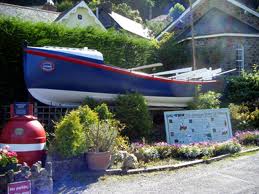
A reconstruction of the Lifeboat "Louisa" at Lynmouth

In 1869 the lifeboat station at Lynmouth, North Devon, opened "on the urgent representation of the local residents".  Its first lifeboat was Henry which was a gift from a lady from Yorkshire, in memory of her brother.  It was launched three times and saved six lives; interestingly it cost £234.  A year later a lifeboat house was built on the west side of the harbour, on land granted by the  Lord of the Manor, Robert Roe at a cost of £292.

On 1st April 1887 a new lifeboat was installed, the Louisa.  It was a 34 foot 3 inch self righting boat, with 10 round oars, a 10 foot sliding steel keel, 2 masts, standing lugs and jib with a No. 2 rig.  It was built by Messrs Woolfe & Son, no. W210, at a cost of £298. 14 s and 0d.  It was met by a donation from the Revd Thomas Littleton Wheeler of Worcester.

By 1894 it was off service for alterations, improvements and updates at the builders yard and five years later a roadway was made through the bolders on the beach, to enable the lifeboat to go out at all states of the tide.  This had to be widened and straightened many times to facilitate launches.

The Louisa was launched a total of 14 times between 1887 and 1906 and saved 24 lives, but one of the most remarkable launches in record was to the ship Forrest Hall on 12 January 1899, when the Lynmouth rescued 15.


To read the full story of the rescue, go to: http://www.lyntonandlynmouth.info/launchb.html - or read the summary below...

At 16, Andrew Richards's father was the youngest crew member of the original rescue mission. He was presented with a watch in recognition of his bravery and it is now a treasured family heirloom. Mr Richards said of his father: "I think he found it difficult to talk about it. He'd rather talk about the amusing aspects of it than the serious side."

The following extract taken from  http://www.somerset.gov.uk/archives/exmoor/richardstsummary1.htm is from Tom Richards recordings:

"Post Office had a telephone message from Porlock saying that there was a ship in distress, blowing a gale. Maroons set up to call the crew down to the lifeboat house. It was impossible to launch the lifeboat. Dad, Jack Crowcombe and Mr. Peter went back to the PO to decide what to do. Decided to take the lifeboat over to Porlock. People had gathered outside the PO from curiosity; they thought it was foolish to launch from Porlock. A fellow was sent to Lynton for 18 horses, quite an industry up there, and they were tied up to the lifeboat. All the women and kids and men hauled the boat up Countisbury Hill; stopped for refreshments at the Blue Ball Pub at the top of the hill. Women were told to go home and the few men left carried on. Had to break down hedges to get the carriage through. Took 7 foot wide skids with them, pulled the lifeboat over the top of those. Terrible job getting down Porlock Hill. Took part of a woman’s garden wall down; still dark but when she realised it was a lifeboat, she helped them down to Porlock Weir. There they launched the lifeboat. Towed the carriage back to Lynmouth. Went alongside the Forest Hall schooner. Got aboard and helped the crew and landed up in Barry for the night. Sailed back next day; a steamer leaving Barry harbour gave them a tow back to Lynmouth. No lives lost. "

The Louisa was overhauled and stored on 10 August 1906, but was later found to be defective and was broken up on 31 October 1906.  The final lifeboat at the station was Richard Frederick Gainer, which saved 41 lives.  Sadly Lynmouth Station was closed in 1944 and the Lifeboat house was swept away in the great floods on 15 August 1952, when three former crew lost their lives.

So why was the lifeboat named "Louisa"? 
And who was the Revd Thomas Littleton Wheeler?

The Wheelers were an interesting Worcestershire family, including three generations of clergymen.  Allen Wheeler, from Kidderminster and Decima Green were married on 6 January 1769 and had two sons Allen born in 1775 and Thomas Littleton in 1777.   Allen was educated at Wadham College, Oxford achieving a BA in 1798 and was created a Minor Canon at Worcester Cathedral on 19 November 1799 and served there until 1855. He achieved a  BD in 1810 and was Headmaster at the College School (Kings) Worcester from 1820 to 1832.  In addition he was the Precentor at the Cathedral from 1820-1851 and was also Rector of Broadwas in 1821.  When he retired from the Cathedral in 1851, he became Vicar at Old Sodbury, Gloucestershire, until his death on Christmas Day, 1855.

At the East End of Worcester Cathedral a 3 light window commemorates Allen and his son Thomas Littleton Wheeler, who paid for the Louisa.

"To the Glory of God and in memory of Allen Wheeler BD born November 20 1775 and died December 25 1855, Minor Canon 1799-1851, Precentor 1820-1851.  And of Thomas Littleton Wheeler MA born February 22 1806, died April 8 1892 Minor Canon 1833-1877, Precentor 1854-1887."

Allen had married Sarah Harvard in June 1801 and had four children: Allen, Margaret Ann, George Augustus and Thomas Littleton and they were baptised at the Cathedral.

Thomas Littleton himself was Rector of Sedgeberrow in 1851 but by 1861 had moved to St Martins, Worcester.  It was in the 1861 census that Thomas and his wife Ann (Bate) had two visitors staying with them, Elizabeth Loscombe who was 30 and her sister Louisa Clifton Loscombe, who had been born in 1814, in Exmouth , Devon!!  These women had their own monies, and were listed as "fundholders"  and later settled in Worcester.  The women both lived in the College Yard Precinct (near the Cathedral) in 1881 and later in life, in the Bull Ring, St Johns, Worcester, where Louisa died in 1892, aged 78 ... , but was this the Louisa of lifeboat fame?

And to finish the story of the three generations of clergymen, Thomas Littleton had a son Thomas Littleton, who himself was a Canon!


With thanks to:
Barry Cox - Honorary Librarian
RNLI
West Quay Road
Poole
Dorset
BH15 1HZ
... for help researching the Louisa

Thursday, 24 February 2011

Henry Haylett of the Norfolk police ... the story of Henry and his father Robert, also a policeman!

Henry Haylett, wife Elizabeth nee Harding and family
Cuckoo Lodge, Holkham Estate

The photograph of the family at Cuckoo Lodge shows Edward, Jane and Alfred, wife Elizabeth, Henry and the dog! and four girls who are likely to be Charlotte, Clara, Rachel and Maria ( in 1901 Clara and Maria were both housemaids, not at Holkham Hall, but somewhere locally) - it is very likely the photograph was taken at the turn of the century.

                                                             *********************

When Henry was born, on 24 February 1850, father Robert was a Police Officer and in 1851 the family lived in Beachamwell, Norfolk, just outside Swaffham.  Robert was 34, his wife Charlotte was just 27 and the Haylett girls: Charlotte 7, Jane 5, Rachel 3 and Maria 2 were the elder sisters of baby Henry.

At this time there was a serious poaching problem in rural areas.  On Monday 1 December 1851, Superintendent Parker, with a dozen rural policemen left Swaffham and went to Letton Park; Robert was one of the men.  The neighbourhood was "infested with gangs of poachers" and the police were hoping to help catch them.  They secreted themselves for many nights, until Saturday 6 December, a bright moonlit night, when they heard shots and moved into the woods.  The poachers fired and severely injured Superintendent Parker and also injured Constable Greenacre. Robert  chased two poachers and he shot at them, he thought he had at least injured them, then he turned back to help Superintendent Parker.  The police were in fact criticised for being involved in this way, but three men were later transported for ten years and another three were imprisoned for two years with hard labour.

Ten years later, in 1861, the family had moved to Fincham and lived on the Main Street and by 1871 Henry had moved out of the family home, Robert was a Sergeant of Police living in Town Street, Upwell and by 1891 Robert was living in Victoria Street, Littleport on his police pension.

In his early years Henry was a gamekeeper, before joining the policeforce in 1868 in the Isle of Ely, when the Chief Constable was Mr Foster, it is amazing to think Henry was just 18.

On 4 July 1870 Henry moved to the Norfolk Constabulary.  His examination documents show how he was 5 feet 11 inches tall, with a swarthy complexion, blue eyes and light brown hair.  His figure was described as "proportionate"!

His career in the police force progressed well:
  • He was raised to 2nd Class on 17 July 1871
  • To 1st Class on 13 January 1873
  • On 24th June 1878 his salary rose to 24 shillings
  • On 5th July 1880 it went up to 25 shillings and then on 19th July 1880 up to 26 shillings.
It was good that he had these increases in salary.  He married Elizabeth (Harding) and when he joined the Norfolk Constabulary he already had a son, Henry Harding Haylett, and by 1881 he had other children: Charlotte, Robert Harding (who later became a Prison Warder at Portland, Dorset), John Macdonald, William, Clara, Rachel (my adoptive maternal Grandmother) and George.  The family were living at Back Street Cottage, Horsham St Faith.

On 27th July 1885 Henry was "raised" to 1st Class Sergeant and by 1891 the family had moved to Wells next the Sea and Charles, Maria, Edward, Alfred and Jane had been born.  Then in 1892, on 1st August Henry became a 2nd Class Inspector, a 1st Class Inspector on 4 December 1893 and a 3rd Class Superintendent on 3rd October 1898.  It was in 1898 that he retired on a pension.

Henry had actually been known to the Holkham Estate Office at Holkham Hall since at least 1889, when he had been a police sergeant in Wells-Next-the Sea.  On his retirement he had moved into Cuckoo Lodge, shortly after building work had been undertaken there - in fact the date 1898 is on the house.  At this point he appeared in the accounts as an employee of the estate.  In the 1901 and 1911 censuses, Henry is reported as being a Private Inspector, working for the Earl of Leicester of Holkham Hall and was living in Cuckoo Lodge, Wells.  The 1911 census states the family included 13 children, all were living.  In fact he was listed in the 'Park and Demesne' section of the accounts until 1913 and was listed as 'Inspector Haylett', on an annual wage of £60.  His rent at Cuckoo Lodge was £2. 7 shillings per annum.

In the mid 1890s when Henry was Sergeant Haylett, he had been asked to keep an eye on goods awaiting transport to Holkham, that were stored on Freeman Street in Wells and to arrange for police to be on duty at an unspecified event.  After his appointment as an estate employee in 1898, he appears to have been responsible for such matters as closure of the park gates on special occasions; prosecuting poachers and cautioning men for shooting in the wrong area; serving notices to quit on cottage tenants and collecting  minor payments due to the estate.

His police background must have been useful.  On one occasion, in February 1913, when a car had run into one of the park gates at night, the agent sent a note to Henry the next morning:
         "Please go at once & see what evidence you can get from the ground & make enquiries as to what cars were in Wells last evening.  Try the Fleece as there were several there".

Fleece Inn, Wells Next the Sea

Henry lived at Cuckoo Lodge, rent free for the last few years, until 1912, when he moved to another estate house in Wells, until June 1917.  Holkham Hall found what is thought to be their last letter to him in Wells in 1924, he had continued to work for the estate until his death later that year.

On 13 June, the Holkham agent, Arthur Tower, wrote to Robert Haylett (Henry's son), in Norwich:
            " I am very sorry indeed to hear that your father has passed away and you have my sincere sympathy in your bereavement.  Your father served this estate for many years in a most satisfactory manner and we shall all feel his loss in many ways."

Cuckoo Lodge was probably built in the 1860s, for its name appears in the 1871 census for Wells.  It still stands in an isolated position just outside the south-east corner of Holkham Park.

With thanks to the Holkham Hall archive
Sources:
- Copy out-letter books 1889 et seq
- Cottage Rental books 1889 et seq
- Estate Accounts A/280 1898
- Cash Book 1898-99


This photograph shows Henry's sons: Charles, William, Robert with Henry
and Robert's wife Lily, Aunt Lil, daughter Jane and her mother Elizabeth
It is most likely this was taken just after 1911

What an interesting insight into the Police and this particular family!


Sunday, 23 January 2011

Edward Grover butcher...not really Jack the Ripper !!


Edward Grover in 1881 was simply a butcher journeyman, living with his wife and children in Fletching, Sussex, but terrible times were to come.
in 1888, it would appear his elderly mother was renting her home from Lord Sheffield, who had property in Fletching and she was about to be evicted. Frances, a widow would have been 73.  In 1881 she had still been farming 9 acres of pasture land in Fletching and at that time she was living in Splains Green Cottage.  At the same time in London, the horrors of Jack the Ripper, the serial killer, frightened everyone in Whitechapel and the news must have travelled to Fletching.
Could Edward stand the situation no longer?  Did he assume the dreaded title “Jack the Ripper”?
In November 1888 it was reported that The Earl of Sheffield was receiving anonymous letters, including a threat of murder by Jack the Ripper. The name was no doubt a hoax but the letter was taken as offensive referring to tenants being turned out of their homes. A reward of £250 was offered for information on the perpetrator.

England, October 27th, 1888. Dear Lord Sheffield. I am sorry, but feeling it is my duty to let you know, as I do not think you do, or would you have the heart to turn out an old tenant like poor Mrs Grover out of her home after such a hard struggle to maintain and bring up her family. Not only that, but allowing anyone to get an honest living there in the butchering line or that have done for a number of years. But it seems to me as though you and your faithful steward want it all, and if you had my wish you would get more than you wanted. Remember, this is a warning to you, but at the same time I should be much obliged to you if you can arrange it for your steward to sleep under the same roof as yourself on Monday night, October 29th, or else I shall have to bring an assistant. My knife is nice and sharp. Oh for a gentleman this time instead of lady. I am sorry for troubling you, but don’t forget the 29th. I remain Yours truly, Jack the Ripper. SAE 6.11.1888’
It would seem Edward was discovered!
The Star, 27 Nov. 1888, contained the following:
“Lord Sheffield Satisfied Now.
Edward Grover was remanded at Uckfield yesterday on a charge of inciting several persons to attempt to murder Lord Sheffield. The prisoner was formerly a butcher at Fletching, living with his mother. Lord Sheffield recently gave the mother notice to quit. Grover was arrested on Thursday night at East Grinstead, but, obtaining leave to go upstairs for a coat, let himself out of a bedroom window by means of a blanket, and escaped barefooted across country to Fletching, where he was re-arrested on Sunday. The prisoner is suspected of having written the threatening letters by which Lord Sheffield has been of late so much annoyed.”

On Sunday 2 December 1888 Lloyd's weekly mentioned that on the previous Monday Edward Grover was remanded at the Uckfield Petty Sessions.  Later in the week, the Bristol Mercury and Daily Post of Thursday 6 December 1888, reported that on the previous Tuesday (4 December), Edward Grover, labourer was committed for trial on the charge of inciting persons to murder the Earl of Sheffield.
On 17 December 1888 Edward was acquitted and discharged at the Autumn Assizes, Lewes, Sussex.   I am pleased to report by 1891/1901 Edward was living with his family in Pulborough, and still working as a butcher/slaughterer.  He died in 1906.
Lord Sheffield died in 1909 and was buried in the family vault in Fletching Church.

Friday, 14 January 2011

The story of two Gloucestershire villages...Eastleach Martin and Eastleach Turville


In Gloucestershire, there are twin villages - Eastleach Martin and Eastleach Turville - flowing between them is the River Leach, but they are joined by a stone clapper bridge, which leads from one parish church to another.  They are just yards apart, facing each other across the river.

St Andrew's Church Eastleach Turville
 St Andrew's is mostly Norman, with a tower roof known as a "Saddleback", an octagonal font and Norman carving by the south door.

St Michael and St Martin's,  Eastleach Martin
 St Michael and St Martin's nave and south door are 12th Century but the base of the font is 15th Century.  Sadly it is no longer in use, but is preserved by the Churches Conservation Trust.
The Keble Bridge

The clapper bridge was named after the Victorian
curate, at Eastleach Martin John Keble, after
which Keble College, Oxford is named.


Inside St Andrews, a story unfolds:


This reads:

Mr Thomas Howes by will dated the second day of June, One Thousand Seven Hundred and Sixty (1760), gave the sum of twenty five pounds (invested in One Thousand Eight Hundred and Twenty Seven (1827)in the Provident Bank for savings at Cirencester) the interest thereof to be laid out in bread and distributed on Easter Sunday in every year in the church porch to TWENTY POOR PERSONS of this PARISH such as the Churchwardens and Overseers, shall in their discretion think fit.
Ben Boyes
and                           {  Churchwardens
Tho. Newport

Thomas Newport was my Great Great Grandfather.  He was born in Eastleach Turville in 1771 and was married  at St Andrew's on 3 November 1791, to Sarah Curtis.  They had many children including the youngest George born in 1831, four years after this plaque, born when Thomas was 60!!  Thomas died in 1850.  George went on to seek his fortune in London.

More to follow ...
                                                                                

Saturday, 1 January 2011

From Work House to Metropolitan Police...the story of Page Mayes Janeway

Page Mayes Janeway was born in 1875, in Royston, Hertfordshire, the son of George Janeway born in 1841 and Mary Ann.  In 1871 George was a fossil digger - labourer.  Sadly in 1880 he died, at just 41, leaving Mary Ann to raise their family.  Clearly they fell on hard times as according to the 1881 census, Mary Ann was living with her sister and brother in law, the Mannings, at Wicker Hall, Therfield, where he was a gardener and Mary Ann, was a jobbing gardener.  Her children: George 11, Walter 9, Page 6 and the baby Eliza Ann just 1 year old, were in the Royston Union Workhouse.


Bassingbourn/Royston Poor Law Union built the Workhouse in 1836, following much protest from the local community.  The picture here shows the Workhouse some years ago when it was being demolished.
Thankfully by 1891 Mary Ann had married Frederick Chalkley and Page had a step father.  The children were reunited with their mother and they all lived in Royston.  Frederick was a stone dresser and Page was an agricultural labourer.

By 1901 however Page's life had changed dramatically.  He was living as a boarder at 450 Commercial Road, Stepney, with a family called Court, Mr Court was a police officer, as was Page and three other PCs boarding there, all in their 20s.

1901 was an important year for Page, now 27,  as on 8 December  he married a 30 year old widow, Emily Russell, who had been living at Trafalgar Road, East Greenwich.  He was then living at at 522 Commercial Road, so still a near neighbour of the Courts. They were married at St James Church, Ratcliffe, Stepney.   Emily's father was Joseph Webb an Ostler and was a witness at the marriage, George, deceased was listed as a fitter.

Years passed and Page, now 37, and Emily moved to 86 Station Road, Epsom.  In 1911, Page was still with the Metropolitan Police.  He had his 13 year old step daughter Helen living with them, and they had two children Leonard 4 and Olive just 3 months old.  It is sad to note that Emily had had 6 children, only three were still living.

It was in 1919 that disaster struck!  Page was serving at the Epsom Police Station.  Following the war there were a number of overseas servicemen awaiting repatriation.  Included were 400 Canadian troops, living in Epsom.  In June police were called to a disturbance at the Rifleman Pub in East Street.


Two Canadian soldiers were arrested and conveyed to the Police Station.  Servicemen followed clamouring for their release.  Policemen went out and dispersed them, however later hundreds of men marched on the station.  Bricks, stones and wood "rained on the police line and the mob surged on the police station".  During the riot Sergeant Green charged into the crowd and was hit on the head, he died the following day.  Page was also injured!


Policemen guarding the Police Station after the riot


This shows the Police Officers at Epsom Police Station - including Sergeant Green and PC Page Janeway

Later the Police Officers who defended the station were presented with gold medallions, onto which was inscribed
 "As a token of public appreciation of the gallant fight by the Epsom Police 17 June 1919"

This is not quite the end of Page's story though!  He died just over seven months later on 2 February 1920.  The Metropolitan Police, Book of Remembrance states:

"PC Page Mayes Janeway died of cancer aggravated when injured in the Epsom Police Station Riot in 1919"

"We are not Manslaughterers - The Epsom Riot and the Murder of Station Sergeant Thomas Green" by Martin Knight
ISBN - 13:9781907183140       Publisher Tontobooks
The book mentions Page Mayes Janeway, and lists cancer in the glands of the neck and cardiac failure as the cause of death.  It also describes how Page had received a commendation in 1904 and tells how he was buried next to Thomas Green in the Epsom Cemetery.

Wednesday, 29 December 2010

The bulb industry in Lincolnshire - Tulips and Daffodils


<><><> 
Rachel Griggs, in April 1955 - aged 3 years 4 months!


My father Herbert Leslie Griggs was a bulb grower in Moulton, Spalding, Lincolnshire, in the 40s, 50s and 60s - he grew both daffodils and tulips.  He originally bought bulbs from Mr Van Geest, from his barrow and later imported bulbs from Holland and bought locally.

The history of the bulb growing industry in Lincolnshire


1900 – 500 acres of bulbs, the main crop was daffodils.


1907 – the first large plot of tulips grown by Sam Culpin.


1931 – 1,500 men and women employed on 3,000 acres of bulbs.


1936 – 2,000 workers on 3,256 acres of bulbs.


1939 – 10,000 acres of bulbs.


1943 – 915 acres of bulbs

.
1965 – 4,000 acres of daffodils, 3,000 acres of tulips and 130 acres of glass.


1966 – Spalding Bulb Company employ 500. 3,000 acres of bulbs of which 500 are tulips.


1967 – Geest take over Spalding Bulb Company.


1975 – 10,000 acres of bulbs, 1,500 of which are tulips.


1985 – 10,000 acres of bulbs, 2,000 of which are tulips.


1999 – less than 1,000 acres of tulips grown by a small handful of growers


Spalding was known as a market gardening area in the 1880s, but it was J T White of Little London, Dick Wellband and Oscar D'Alcorn (in 1901 Oscar was 38 and listed as a bulb farmer of 50 London Road, Spalding) who pioneered the bulb industry, growing tulips, daffodils, crocus, snowdrops and iris.  Other early growers were: Elizabeth Quincey of Fulney, George Dickenson of Whaplode and Henry Knipe of Bourne. Records also show that Sam Culpin grew the first plot of tulips commercially in 1907.  In fact Darwin tulips were first introduced in 1905 and Samuel grew three: Clara Butt, William Copland and Rose Copland, which are still popular varieties today.

The Culpin family carried on bulb growing over many years. In 1881 Sam ran the Punch Bowl and in 1891 son Fred ran the Royal Oak, but by 1901 Frederick was listed as a farmer and bulb grower.  By 1911 it was a real family business Sam was now 83, Fred aged 45 is listed as a bulb grower and son Fred 20, son Robert Samuel 14 and daughters Florence Ann 18 and Elizabeth May 16 were all assisting in the bulb growing business and they all lived at Narcissus Gardens, Spalding.  In 1930 Fred of Low Road, Spalding died leaving £11,141 to his sons: Fred and Richard  were  bulb growers and Robert Samuel was a farmer.

Another important family was the Taylor's.  Otto Augustus Taylor (founder of AO Taylor) took over a small holding in 1919, provided by the Government of the day, for ex serviceman, from the First World War.  He decided to grow flowers and bulbs and became one of the pioneers of bulb growing.  My father bought bulbs from the company and today they sell to most nurseries in the UK!

The Dutch links arose when the Geest brothers John and Leonard Van Geest came to Lincolnshire in the 1930s.  The family had been involved in flower growing and horticulture since the late 19th century in Holland.  In 1935 Geest Horticultural Producers began growing their own flower bulbs, rather than relying on Dutch imports.

With the coming of the railways, flowers were sent to markets, towns and cities, which cheered dark, polluted, industrial areas and homes!


Les and Daisy Griggs, boxing up bulbs, note the Ransome tractor

By 1931 1500 men and women were employed on 3000 acres of bulbs.  Early flowers were sold open, with no central heating, flowers lasted well!  People also liked to see what they were buying.  They were bunched on frames and tied with raffia.  Boxes were lined with paper and the boxes were then sent to the markets.


Les Griggs's bulb growing business, Cobgate Road (now East Cobgate) Moulton.  It shows greenhouses and fields and the dark square in front of the greenhouses was a cold store, quite an innovation and one of the first in the area.


Spalding Bulb and Produce Auction

Before the Second World War, smallholders and small farmers could only work with dealers if they wanted to sell their bulbs and produce, but after the war, four auctioneers held their own individual auctions.  By 1948 it was felt it would be a good idea if the four auctions were amalgamated.  The first combined auctions were held in a marquee, but as the auction was so successful, within two years several permanent buildings were constructed.  Bulb sales were held between August and December, with the sale of gladioli taking place on Tuesdays in season.

People used to travel from all over the country to buy, and bulbs were entered into the sale from Holland, Ireland, Cornwall and Scotland!  At the end of the 1950s the four auctioneers were Mr R A Longstaffe; Mr G Kingston; Mr N Price and Mr J H Tateson, selling 30 million tulip bulbs through a season and 1500 tons of daffodil bulbs, not to mention the cut flower sales!  In 1955 a dozen Rose Copeland made 1s.2d to 4s.9d and a dozen Fortune daffodils 1s.4d to 2s.6d and the ever popular Cheerfullness 1s.7d to 2s.11d!  That was the year that The Tulip Queen, Janet Naylor,  was crowned on 20 April, in Ayscoughfee Gardens by Derrick De Marney, an actor.  He is perhaps best known for his starring role as Robert Tisdall, wrongly accused of murder in Alfred Hitchcock's Young and Innocent (1937).

Do watch - http://www.britishpathe.com/record.php?id=9897
Which shows girls picking/gathering daffs from the fields in 1929, and the end shows bunching the open daffodils on frames, 4 lots of 3, for the traditional dozen open flowers - each bunch was tied twice with raffia, in later years twist ties were used!! They are then put into boxes for market!